
An examination of the recent technology market correction, why it reflects a recalibration of expectations around AI rather than the end of the investment theme, and why diversification remains a more resilient strategy than either chasing, or abandoning, the market’s latest obsession.
Overview
Global markets suffered a sharp reversal as investors abruptly reassessed the outlook for artificial intelligence and technology spending. Roughly US$2.5tn was wiped from Wall Street in a single session, while South Korea's Kospi plunged almost 9 per cent, as technology stocks recorded some of their steepest declines in years.
The immediate catalyst was concern that the recent US election results could slow the pace of AI-related infrastructure investment. Yet markets rarely erase trillions of dollars of value because of a single political event.
The scale of the reaction points to something deeper: growing unease that expectations surrounding artificial intelligence may have moved ahead of economic reality. In many respects, this correction represents the market’s first serious attempt to separate the long-term promise of artificial intelligence from the near-term economics of delivering it.
The AI trade had become one of the most crowded positions in global markets. Semiconductor manufacturers, hyperscale cloud providers and data centre beneficiaries were increasingly priced for near-perfect execution. Investors became comfortable assuming that record capital expenditure would inevitably lead to record profits.
History suggests that such assumptions rarely go unchallenged. Transformational technologies have consistently created enormous wealth over time. Railways, telecommunications, the internet and cloud computing all reshaped economies and generated exceptional long-term returns. Yet each also experienced periods when investor enthusiasm raced ahead of commercial reality, leading to painful corrections before sustainable winners emerged.
Artificial intelligence may ultimately follow a similar path. The technology is real. The opportunity is substantial. The journey, however, is unlikely to be linear.
The immediate catalyst was concern that therecent US election results could slow the pace of AI-related infrastructureinvestment. Yet markets rarely erase trillions of dollars of value because of a single political event.
The scale of the reaction points to somethingdeeper: growing unease that expectations surrounding artificial intelligencemay have moved ahead of economic reality. In many respects, this correction represents themarket’s first serious attempt to separate the long-term promise of artificialintelligence from the near-term economics of delivering it.
The AI trade had become one of the mostcrowded positions in global markets. Semiconductor manufacturers, hyperscalecloud providers and data centre beneficiaries were increasingly priced for near-perfect execution.Investors became comfortable assuming that record capital expenditure wouldinevitably lead to record profits.
History suggests that such assumptions rarelygo unchallenged. Transformational technologies have consistently createdenormous wealth over time. Railways, telecommunications, the internet and cloudcomputing all reshaped economies and generated exceptional long-term returns.Yet each also experienced periods when investor enthusiasm raced ahead of commercial reality,leading to painful corrections before sustainable winners emerged.
Artificial intelligence may ultimately followa similar path. The technology is real. The opportunity is substantial. Thejourney, however, is unlikely to be linear.
The Sell-off:What Happened and Where
Few investors doubt that AI has the potentialto transform industries, enhance productivity and reshape the global economy.It is about whether the extraordinary levels of investment required today can generatereturns sufficient to justify current levels of spending.
The recent weakness in technology shares hasnot been a broad rejection of the sector. Instead, it has been a concentrated repricing ofcompanies most closely linked to the AI infrastructure buildout.
Technology benchmarks have fallenapproximately 12–13 per cent from their early October highs, but beneath the headline indicesthe damage has been highlyuneven. The epicentre of the decline has been among companies directly exposed toAI-related capital expenditure. Nvidia fell 24.1 per cent from its recent peak, while Broadcom declined22.6 per cent. Alphabet and Meta each experienceddrawdowns of more than 20 per cent as investors reassessed both the scale offuture spending requirements and the timeline for achieving meaningful returns.
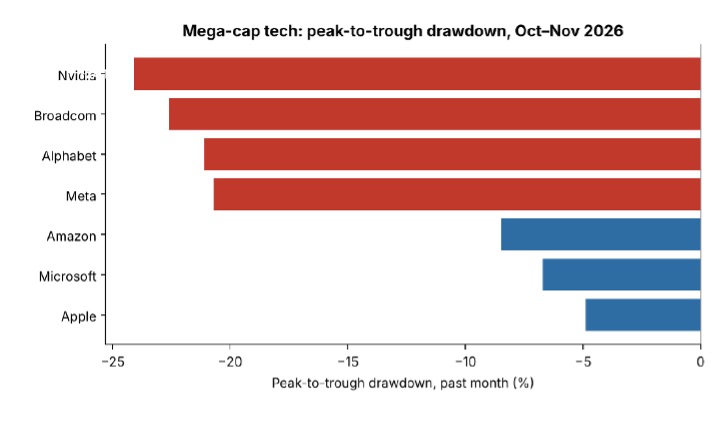
Nvidia’s 9.3 per cent declineon 5 November was particularly notable, highlighting the elevated volatility that oftenaccompanies market leadership. Companies that have delivered extraordinarygains frequently experience the sharpest reversals when sentiment shifts. Bycontrast, several large technology companies have proven more resilient. Amazondeclined 8.5 per cent from its peak, Microsoft fell only 6.7 per cent and Appleless than 5 per cent.
The divergence reflectsan increasingly importantdistinction being drawn by investors: between businesses viewed asproven monetisers of AI and those where future returns remain heavily dependenton continued infrastructure investment.
Markets appear willingto reward demonstrated earnings power. They are becomingless willing to pay unlimited multiples for future possibilities. Thisdistinction matters because it suggests the sell-offis not a rejection of artificial intelligence itself. Rather, it is a reassessment of how much investorsshould be willing to pay for exposure to it.
Why This Is Not theTMT Bubble 2.0
Comparisonswith the technology bubble of the late 1990s have become increasinglycommon. As a reminder from the peak in 1999 the Nasdaq fell over 70% from itspeak in 2000 to the low in 2002, while the broader S&P500 market fell over50%. While some parallels exist, the differences are more important than the similarities.
The defining characteristic of many internetcompanies during the TMT era was the absenceof sustainable profits. Valuations were often justified by website traffic,user growth or hypothetical future business models rather than demonstrableearnings power.
Today’s market leaders stand in sharpcontrast. Microsoft remains one of the world’s most profitable companies,generating substantial recurring cash flows from software, cloud computing andenterprise services. Nvidia has become the critical infrastructure providerunderpinning much of the AI ecosystem, producingoperating margins and cash generation that many businesses can onlyaspire to achieve.
Recent earnings from both companieshave reinforced this distinction. Revenuegrowth remains robust, profitability remains exceptional and demand forAI-related services continues toexpand. Importantly, valuations across the sector are far from uniform.
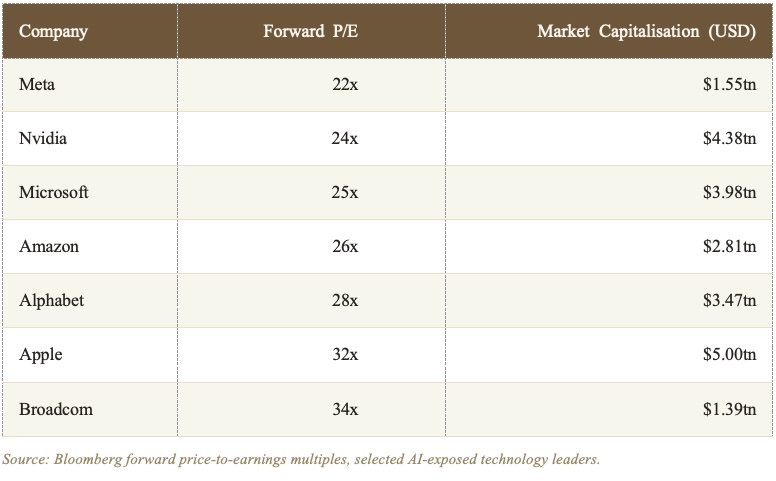
As the table illustrates, currentvaluations vary meaningfully by name. While these multiples are not inexpensive, they areconsiderably lower than those observed during previous speculative episodes. Several of the largest AI beneficiariestrade on earnings multiples that sit broadly within historical market ranges.
Investors were broadly correct about theinternet. They were simply too optimistic about how quickly economic benefitswould emerge and how much they should pay in advance for those benefits. Asthe late technology boom demonstrated, bubbles are rarely built on bad ideas.More often, they are built on good ideas carried to excess.
Why Diversification Still Matters
Perhaps the most important lesson from thiscorrection has little to do with artificial intelligence.It is a reminder that diversification remains one of the few enduringprinciples of successful investing.
Bull markets have a tendency to convinceinvestors that concentration is a virtue. As a handful of winners dominatereturns, holding anythingelse can appear unnecessarily cautious. Exposure becomes increasinglyfocused on the themes that have performed best, and the benefits of diversification can begin to feel theoretical. Untilmarket conditions change.
History offers numerousexamples. The Nifty Fifty in the 1970s, technology stocks at the height of the dot-com boom and bankand property shares before the global financial crisis all representedcollections of high-quality businesses whose valuations eventually became detached fromrealistic expectations.
The recent AI correction serves as a modernreminder of the same dynamic. When valuations become demanding and investorpositioning becomes crowded, markets become increasingly sensitive to changes in sentiment. Liquiditydeteriorates, correlations rise and price movements become detached fromunderlying fundamentals.
In such periods, having conviction in a themealone is often insufficient protection. A portfolio diversified across asset classes,sectors, regions and investment styles may appear lessexciting during periods of market concentration. Yet it is typically far moreresilient when sentiment turns and capital begins searching for the exits.
For families and long-term investors, thatresilience is often more valuable than maximising returns over any singlemarket cycle. The lesson from recent weeks is not that artificial intelligencewill fail. Nor is it that investors should abandon exposure to one of the mostimportant technological developments of our generation.
Rather, it is that even the most compellinginvestment themes remain subject to the disciplines of valuation, investorpsychology and market cycles. The destination may be clear. Thejourney, as markets have once again reminded us, is rarely smooth.
“The recent technology sell-off is unlikely to be the last such reminder. Nor, for disciplined investors, should it be forgotten.”