
A review of the forces behind the main developments in financial markets, the sharp move higher in bond yields, what it means for investors, and how to position portfolios to benefit from a higher-yield environment.
Overview
For much of the past decade, investors faced a tough challenge: generating meaningful income without taking significant risk was almost impossible. Today that environment has changed. While equity markets continued to make new highs during the third quarter and the global economy proved more resilient than expected, the most consequential move in financial markets in Q3 was not in equities but in the bond market.
By quarter end the 10-year US Treasury yield had hit 5.3%, a level not seen in decades as the global economy proved more resilient than expected and inflation pressures persisted. In this letter, we examine the forces behind this shift, what it means for investors, and how portfolios can be positioned to benefit from a world where income once again matters.
Market Performance
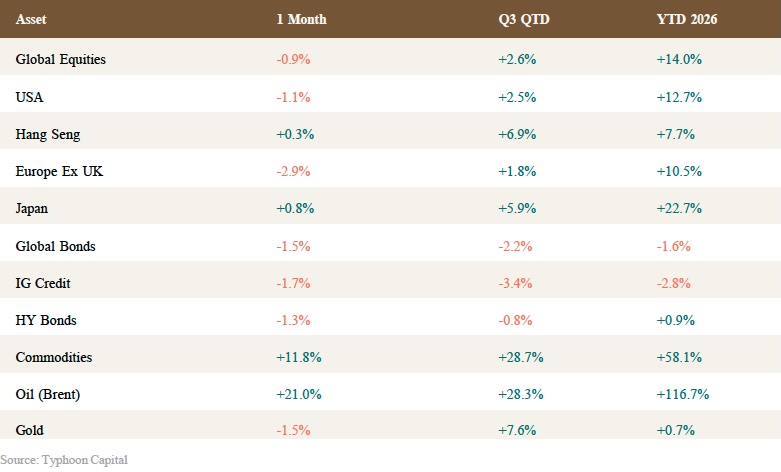
So far this year there has been an unusually wide dispersion of outcomes across asset classes: equities have gone on to post strong double-digit gains for the year, commodities have surged further, government bonds have continued to struggle (See Performance Table below).
Equities: Equity markets delivered another positive quarter. In Q3 Global Equities rose 2.6%, extending an already strong year and are now up 14.0%. Yet the headline gains masked a growing divergence beneath the surface. Market leadership became increasingly concentrated in a handful of large-cap technology and AI-related companies, while smaller companies and economically sensitive sectors struggled. At a regional level the biggest winner is Japan. The Nikkei is up 22.7% year to date as investors continue to back an improving economic backdrop, putting money to work again in Japanese companies amid signs of economic improvement.
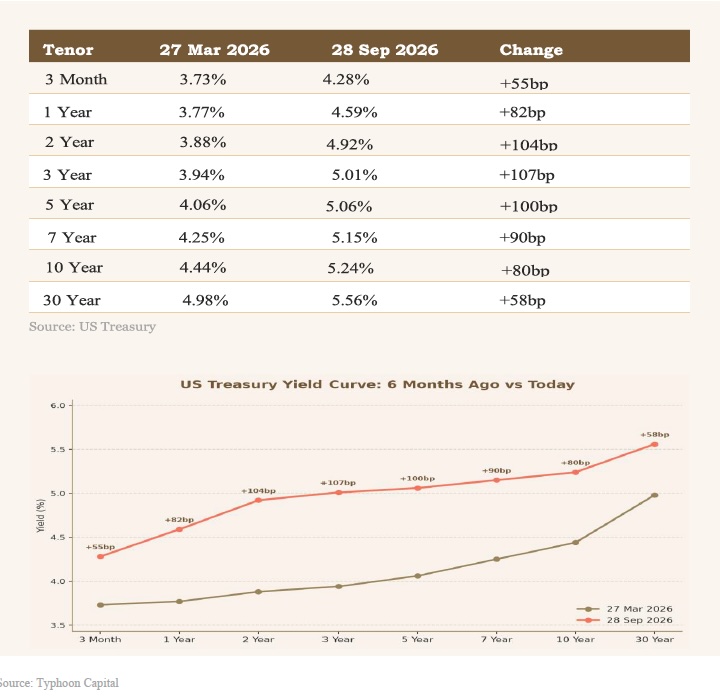
Bonds: Due to persistent inflation and rising interest rates sovereign bond and credit markets struggled. Longer-duration bonds suffered more as investors demanded higher compensation for persistent inflation. The 10-year Treasury yield rose by almost 90 basis points during the quarter, one of the sharpest increases in recent memory. move this fast, or this far, without consequence for every portfolio that holds fixed income.
Commodities: Commodity markets were among the strongest-performing asset classes globally. Brent crude oil is now up more than 100% for the year, above $100 a barrel as disruption around the Strait of Hormuz has persisted, and that has kept upward pressure on prices. Despite higher yields available on bonds Gold is relatively unchanged year to date.
How different Maturity Bonds have Performed
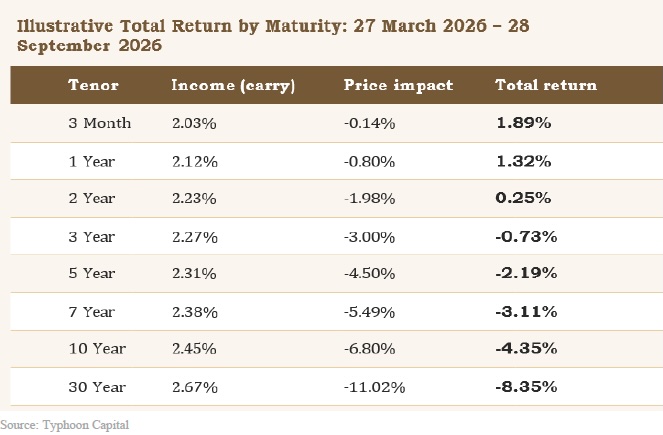
Investors holding longer-duration bonds have been hit hardest by the recent rise in yields. Over the past six months, 30-year US Treasuries have fallen approximately 8.35%, reflecting the greater sensitivity of long-dated bonds to changes in interest rates, inflation expectations and government borrowing needs. As yields rise, the price impact is magnified for bonds with longer maturities, resulting in larger capital losses.
By contrast, shorter-duration bonds have proven far more resilient. One-year US Treasuries have delivered a positive return of approximately 1.32%, supported by higher income and minimal exposure to interest-rate risk. This divergence highlights a key lesson for investors: when yields are rising, shorter-duration bonds can provide attractive income while limiting capital volatility, whereas longer-duration bonds remain significantly more exposed to further moves in interest rates.
The Fed raises Interest Rates
Economic growth remained solid throughout the quarter, supported by strong corporate investment, continued consumer spending and ongoing demand for AI-related infrastructure. Labour market conditions also remained healthy, with unemployment holding near 4.1%. Rather than signaling a recession, most economic indicators pointed to an economy continuing to expand at a respectable pace.
The principal source of strength remained the American economy. Corporate investment has continued at a healthy pace, underpinned by spending on artificial intelligence and digital infrastructure. US consumers, meanwhile, have proved more resilient than expected, continuing to spend despite the highest borrowing and fuel costs in years. This resilience is both good news and a challenge for markets. Stronger growth supports corporate earnings but also reduces the urgency for monetary easing.
Against this backdrop, the Federal Reserve resumed raising interest rates in September, by 25 basis points to a range of 3.75%–4.00%, marking the first-rate increase in more than three years. The decision reflected concerns that inflation was proving more persistent than expected and that economic activity remained sufficiently strong to absorb tighter financial conditions.
The Consequence of Higher Rates
Rising bond yields matter far beyond financial markets. The yield curve (See Chart below) is in effect, the price of money across an economy. When government bond yields rise sharply, borrowing costs increase for households, companies and governments alike. Higher Treasury yields are quickly reflected in mortgage rates, corporate borrowing costs and bank lending rates. For consumers, this can mean more expensive mortgages, car loans and credit card debt, weighing on spending and housing activity. For businesses, the cost of financing new projects rises, making investment decisions more difficult and often slowing expansion plans.
In short, higher yields act as a brake on economic activity. If they remain elevated for long enough, growth tends to slow. The key question for markets is whether today's higher yields simply reflect a strong economy, or whether they eventually become restrictive enough to weaken it. That distinction will shape the outlook for both bonds and equities over the coming quarters.
Nvidia in Focus
Technology has once again been the dominant equity story of the year, though performance within the sector has been far from uniform. Semiconductor stocks, the primary beneficiaries of the surge in AI infrastructure spending, have led the market higher, rising approximately 75% year-to-date.
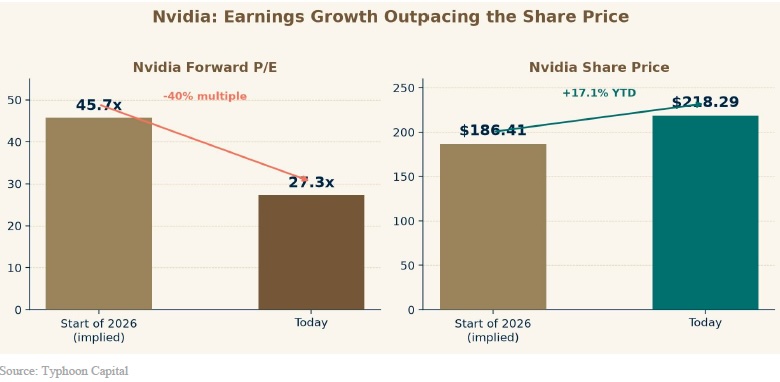
Nvidia remains the clearest bellwether for the AI investment cycle, and its recent results help explain why enthusiasm for the company remains strong. While the shares have gained a respectable 17.1% year-to-date to $218.29, the stock has actually become significantly cheaper on a valuation basis. Earnings growth has far outpaced the share price, driving the forward price-to-earnings multiple down from around 45.7x at the start of the year to 27.3x today.
This represents a notable de-rating. Nvidia still commands a premium to the broader market, but that premium is now considerably smaller than it was a year ago. In effect, the market has become less willing to pay for future growth even as the company's earnings trajectory has continued to improve.
We highlighted a similar disconnect in Microsoft earlier this year. Despite concerns around valuation, strong earnings growth ultimately drove a substantial reappraisal of the stock, with Microsoft rising 37.5% in Q3 alone and adding roughly $1 trillion in market value. While Nvidia would be difficult to describe as inexpensive in absolute terms, the shares appear considerably less demanding relative to their growth prospects than they did twelve months ago. For investors seeking exposure to the long-term expansion of AI, that combination of powerful earnings growth and a lower valuation multiple remains compelling.
What matters most for Investors
In summary for investors, the message from the global economy is broadly constructive. Recession risks remain lower than feared, corporate earnings continue to benefit from a healthy growth backdrop, and labour markets remain resilient.
However, stronger growth has come at a price. The combination of persistent inflation, higher government borrowing and elevated interest rates suggests that the era of exceptionally cheap capital is firmly behind us. Markets are adjusting to a world where growth remains positive, but where money is no longer free.
The central message from Q3 is that bond markets are once again setting the agenda and offering a credible alternative to other investments. Yields above 5% on US Treasuries provide investors with a level of income that has been absent for much of the past decade. At the same time, higher discount rates create a more demanding environment for equity valuations and increase the risk of volatility across financial markets.
For long-term investors, the opportunity is clear: attractive yields can now be accessed through high-quality fixed income without taking significant credit risk. After years in which there was little alternative to equities, bonds have re-emerged as a meaningful source of both income and portfolio diversification.
Our house view remains that portfolios should be built to endure the full range of outcomes, not just the ones we expect. The rotation this year, from a growth scare toward a reflation/energy shock, and back toward risk-on, is exactly the kind of regime change that argues for staying diversified across growth, defensive and real-asset exposures rather than making a single directional bet.
“The higher-yield environment now on the table is the first genuine
opportunity in years to generate meaningful income from
high-quality bonds, without reaching down the credit-quality
or liquidity curve to do it.”
TYPHOON CAPITAL · INVESTMENT COMMITTEE