
A review of the forces behind the sharp move higher in bond yields, what it means for investors, and how to position portfolios to benefit from a higher-yield environment.
Why This Matters
Bond yields influence the entire global economy, affecting everything from mortgage rates to consumer spending and investment. When yields rise, economic growth can slow potentially impacting riskier assets like equities. For investors, however, higher yields are not simply a risk. They are also an opportunity to earn higher returns.
Since the outbreak of the Iraq war, bond yields have risen sharply, with the US 10-year Treasury recently reaching 5.2%, a level not seen in decades. Higher oil prices, firmer economic growth and expectations that interest rates may remain higher for longer have driven a significant repricing across fixed-income markets.
Bond yields do not move this fast, or this far, without consequence for every portfolio that holds fixed income. The adjustment has unsettled investors. Yet it has also created one of the most attractive opportunities in years for those seeking income and capital preservation.
Why Bond Yields Have Moved Higher
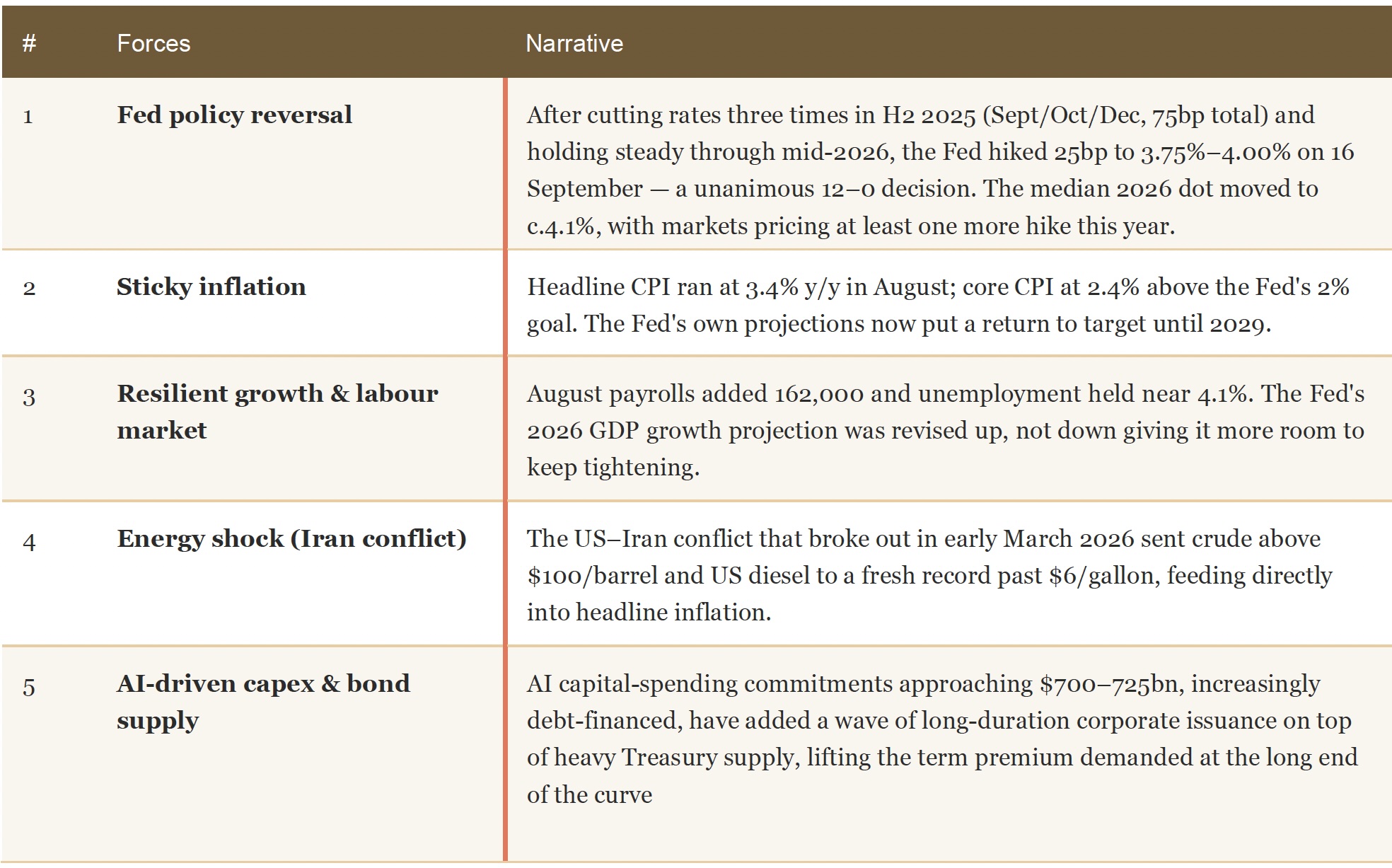
Five forces are now pulling in the same direction at once, something that has not happened in years
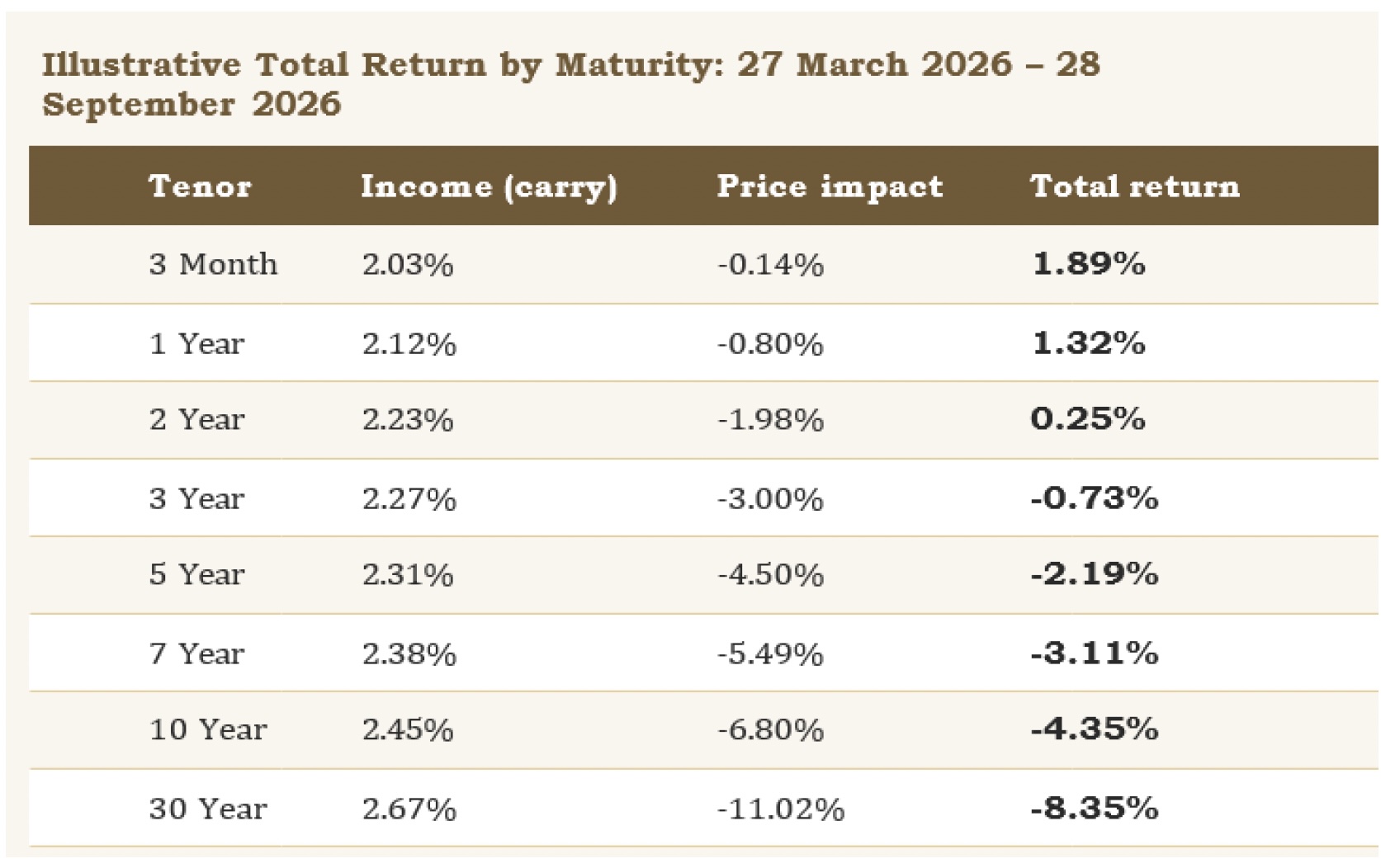
Duration Impact: How different Maturity Bonds have Performed
Bonds have lagged most major asset classes this year as rising yields have pushed prices lower. Investors holding longer-duration bonds have fared particularly poorly. For example, investors holding 10- ear US Treasuries have endured a 4.35% decline in the last 6 months, while 1 Year US Treasuries are higher by 1.32%. The difference comes down to a single number: duration.
While short-dated bonds have benefited from higher income and limited price sensitivity, long-dated bonds have suffered larger capital losses as markets repriced the outlook for interest rates, inflation and government borrowing.
Bond Maturity or Duration measures how sensitive a bond's price is to changes in interest rates. Short-dated bonds typically have low duration because investors receive their principal back relatively quickly. Long-dated bonds have much higher duration because investors must wait many years to recover their capital, making them far more exposed to changes in interest rates and inflation expectations.
The higher the duration, the larger the price movement for a given change in yields. As a rule of thumb, a bond with a duration of five years will lose approximately 5% of its value if yields rise by one percentage point and gain roughly 5% if yields fall by the same amount. Two bonds can therefore experience very different outcomes even when exposed to the same market environment.
The lesson is straightforward: In fixed income, it is not just the direction of rates that matters. It is how much duration a portfolio carries. Put simply, yield changes tell you where the market has moved. Duration determines how much that move affects your portfolio.
Why Higher Yields matter for Investors
For much of the past decade, generating meaningful portfolio income often required taking additional credit, liquidity or equity risk. The recent stresses in parts of the private credit market are a reminder of the trade-offs investors have made in pursuit of yield. That calculus has changed. Investors can once again earn compelling returns from high-quality government and investment-grade bonds without sacrificing liquidity or credit quality.
This shift is significant. Today, higher bond yields provide a stronger foundation for long-term portfolio returns, they offer downside protection in a recession, improve diversification and offer income from financially sound issuers. At the same time, they raise the hurdle rate for riskier assets like equities, making selectivity increasingly important across equity and alternative markets.
Rising yields may have hurt bond prices in the short term, but they have improved the long-term outlook for bond investors. A simple principle applies: the higher the starting yield, the higher the expected return that investors can lock in over time. While the journey may be volatile, investors purchasing bonds at higher yields are beginning from a much stronger position than they were just a few years ago.
The transition to a higher-rate world may prove has restored something investors have not enjoyed for many years: the ability to earn attractive income from high-quality assets. For patient investors, that is less a challenge than an opportunity.
Putting Higher Yields to Work
A structurally higher-yield environment is the first genuine opportunity in years to generate meaningful income and returns, from high-quality fixed income assets, without reaching down the credit-quality or liquidity curve to do it.
So, what should investors do?
1. Revisit cash and near-cash allocations. Money-market and short-duration instruments are now paying yields last seen many years ago. For the portion of a portfolio held for liquidity or near-term spending needs, this is a genuine improvement in the “cost” of holding cash in a bank account.
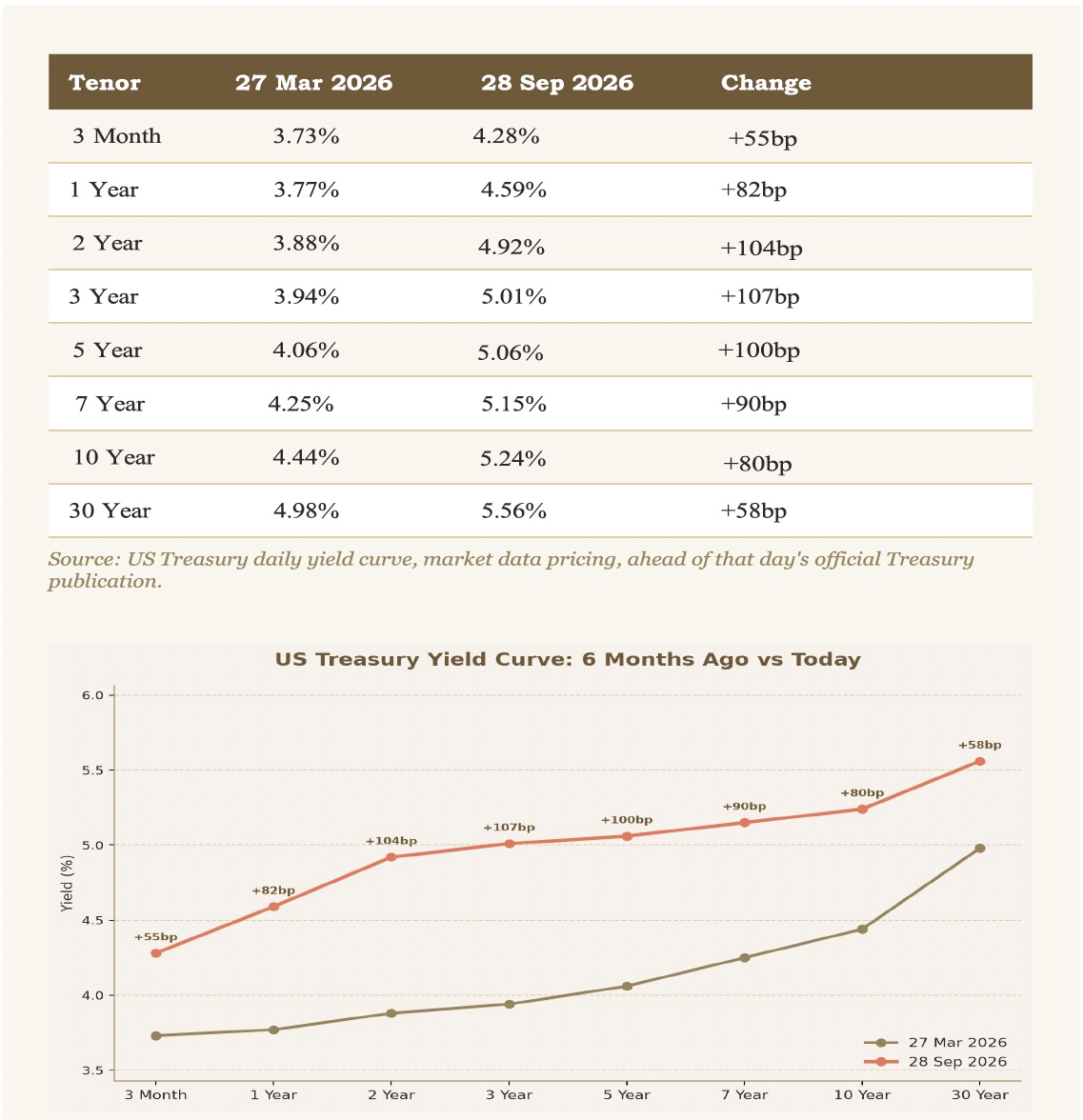
2. Reset income at today's higher starting yields. With the front end of the US curve now above 4.5% from the 1-year point out, and above 5% from the 3-year point, high-quality government and investment-grade paper again pays a competitive, contracted yield on its own. Portfolios that were underweight duration through the low-rate years now have a genuine opportunity to lock in these higher starting yields, rather than treating fixed income purely as a diversifier.
3. Use short-to-intermediate duration to capture less volatile income. The 2–5-year part of the bond curve has repriced by the most (100bp+) and carries meaningfully less price risk than long-dated bonds if yields move further. This combination (attractive yield, moderate duration risk) makes short duration bonds a sensible core allocation for capturing today's higher rates without taking on the outsized price swings of the long end.
4. Consider investing (laddering) across maturities. Rather than concentrating in a single tenor, a maturity ladder, spreading holdings across, for example, 2, 3, 5 and 7-year maturities, captures today's higher yields across the curve while reducing reinvestment risk: some bonds will always be maturing and available to redeploy, whichever way rates move next.
“The higher-yield environment now on the table is the first genuine opportunity in years to generate meaningful income from high-quality bonds, without reaching down the credit-quality or liquidity curve to do it.”
TYPHOON CAPITAL · INVESTMENT COMMITTEE