
With cracks emerging in parts of the equity and private credit market, hedge funds can offer vital resilience to a portfolio.
As we look across financial markets today, we see an investment landscape that remains broadly constructive but also noticeably more nuanced than in recent years.
Renewed geopolitical tensions have increased the risk of higher inflation ahead; cracks are appearing in segments of the equity market on AI fears, most noticeably in the software sector, while private credit funds are facing redemptions from concerned investors.
In this environment, our focus is on ensuring that portfolios are positioned not just for the opportunities and risks of today, but for the full range of outcomes we may encounter over the coming years.
Why the Traditional Toolkit Is Evolving
One of the clearest themes emerging from our work is the increasing importance of hedge funds, as a core component of a well balanced portfolio.
For sure, equities will always remain central to long term wealth creation, and similarly bonds play an important role for both income and diversification but more importantly downside protection.
However, the world is no longer driven by a single dominant narrative, such as the decade long era of ultra-low rates that lifted all boats. Instead, we are seeing greater dispersion across sectors, business models, and even regions. This is not a cause for concern; rather, it is a call to broaden the sources of return within portfolios.
Why Hedge Funds matter more now
Looking ahead we think that markets are likely to be more selective, and the strategies that outperform from here will be those that can identify mispricing, adapt quickly, and capture opportunities beyond the traditional long only framework.
Long Short Hedge Funds' ability to protect on the downside and generate returns from differentiated sources, many of which are not accessible in traditional portfolios, makes them uniquely well-suited to today’s environment. Let me highlight three reasons why I believe they merit a more strategic allocation:
1. Access to Distinct Return Streams
Hedge funds can deliver returns from areas where traditional strategies simply cannot participate. This includes long/short equity opportunities, relative value trades, and market neutral and sector specific approaches designed to extract pure alpha. These return drivers help reduce the reliance on broad market beta.
2. A more liquid Complement to Private Markets
Private assets remain important long-term tools in portfolio construction, and we will continue to allocate to them selectively. However, these asset classes are inherently less liquid and can be slower to adjust to shifting market dynamics. Hedge funds can serve as a liquid counterpart, providing active risk management, more frequent repositioning, and the ability to respond as conditions evolve.
3. A Strong Focus on Capital Preservation
One of the qualities I value most in alternative strategies is their flexibility. Hedge fund managers can moderate exposure, hedge specific risks, or pivot quickly as new opportunities emerge. This adaptability makes them particularly useful in building resilience into portfolios without giving up return potential.
4. Higher Return with lower risk?
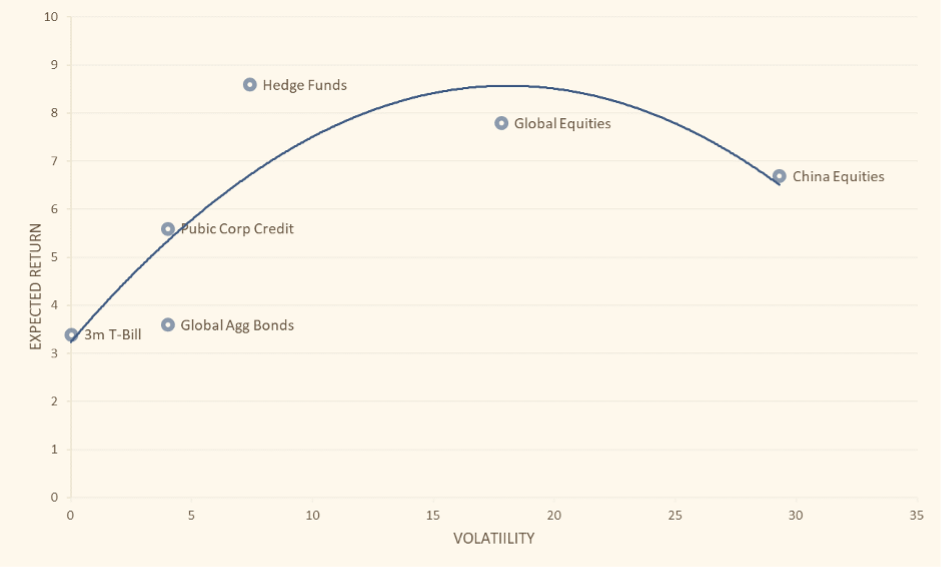
Recent long term capital market assumptions reinforce the structural role hedge funds can play. According to major asset allocation frameworks, like Blackrocks Capital Market Assumptions shows that hedge funds are projected to deliver higher expected returns than equities and bonds over the next five to ten years, with meaningfully lower volatility than equities.
Figure 1: Hedge Funds: Higher returns with less risk?
How we are Positioning Portfolios
At Typhoon Capital, our philosophy is rooted in balance, not in predicting a single outcome, but in preparing for many. As part of this, we are increasing the strategic relevance of hedge Funds within portfolios.
By integrating carefully selected hedge fund strategies, we aim to:
• Enhance diversification
• Reduce volatility
• Improve risk adjusted returns
• Access differentiated sources of alpha