Why This Question Matters
Every HNW family eventually asks the samequestion: should our wealth sit inside one private bank's balance sheet andproduct shelf, or should it be advised independently, with the bank reduced toa custodian? The answer shapes cost, conflicts,continuity and control.
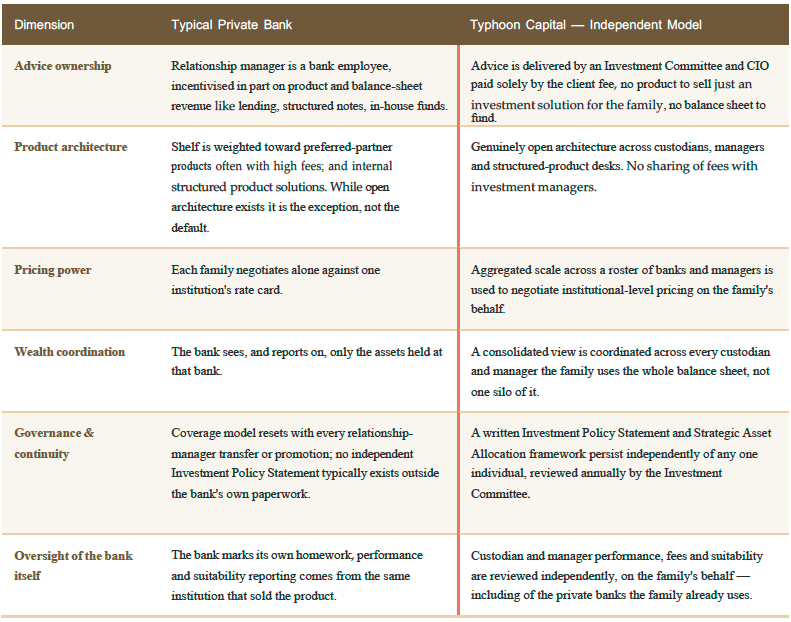
Private banks and independentmulti-family offices are structurally different businesses, not just differentprice points on the same service. The private wealth industry's own literature separates them by ownership of the advice (who decides what you buy), ownership of the product(who manufactures what you buy) and ownership of the relationship (who is accountable when the two conflict). TyphoonCapital's model is built to keep those three functions separated which a structural choice, not a marketing one.
The Structural Difference
A private bank's economics are built on investment fees, deposit-taking, lending, brokerage, custody and advice sit inside one licensed entity. As per the standard private wealth industry taxonomy, its revenue mixes recurring fees (management, custody, fund trailers) with variable, transaction-linked revenue like trading spreads, structured-product mark-ups, FX spreads, new-issue placements. The relationship manager who advises you and the desk that manufactures or distributes the product both sit on the same P&L.
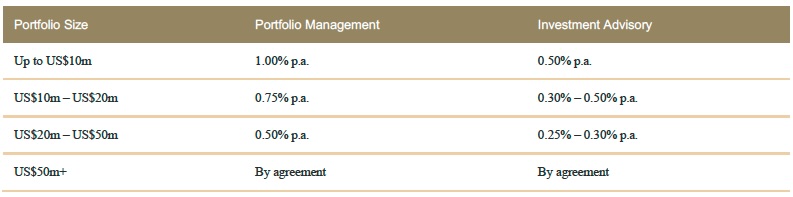
An independent multi-family office is built the other way round: it holds no balance sheet, manufactures no proprietary product, and is paid a single, disclosed fee on assets under advice or under management by the family itself. Typhoon Capital's own published schedule (0.25%–0.50% for Investment Advisory; 0.50%–1.00% for discretionary Portfolio Management, tapering as assets grow) is the entire commercial relationship: no custody mark-up, no trailer fee, no placement fee sits underneath it.

Side-by-Side: Six Dimensions Families Should Test
Fees: Simple and Published vs. Bundled and Opaque
The private wealthindustry's own fee taxonomy splits bank revenue into recurring andnon-recurring, fixed and variable components layered across advice, custody,lending and trading. Each layer is individually modest; stacked together acrosscustody, transaction, structuring, investment management and fund-manufacturingmargins, the client-facing cost of a private-bank relationship is frequentlyhigher, and harder to see in one number, than a single, disclosed advisory fee.
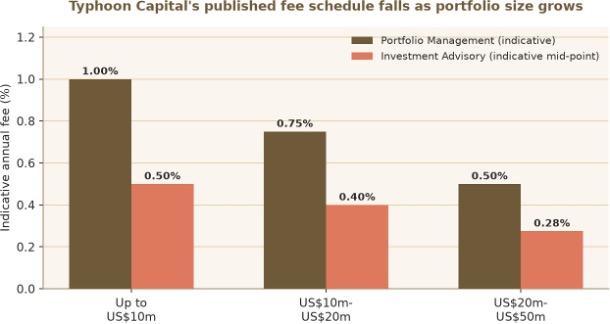
Source: Typhoon Capital'spublished Investment Advisory/ Portfolio Managementfee schedule (client-provided presentation, September 2026)
Depth of Expertise, Redeployed Independently
Typhoon Capital's Investment Committee is built from people who ran these functions inside the institutions families are comparing it to including a ChiefInvestment Officer who led the Chief Investment Office for UBS wealth arm inLondon and held senior investment roles at two further institutions; a SeniorFamily Advisor with three decades in HNW advisoryand fixed-income leadership across several global banks; a Head of Investment Operations drawn from prime brokerage risk andclient-reporting roles at two bulge-bracketfirms. The insightinto how a private bank's incentives actually work inside the building is first-hand, nowapplied entirely on theclient's side of the table.
What This Means for a Family ChoosingBetween the Two
The private bank remains valuable for what it does well: balance-sheet lending, custody, execution and banking infrastructure. The open question is who directs the investment decisions sitting on top of that infrastructure, and who is accountable if a recommendation serves the house better than the family.An independent multi-family office does not replace the private bank, it sits above it, coordinating multiple custodians, negotiating on the family's behalf, and holding every provider (including the family's existing banks) to independent account against a written policy the family owns.
For a family withmeaningful complexity, multiple custodians, multiple generations, illiquid andprivate holdings alongside listed markets, the practical choice is rarely"bank or advisor". It is whetherthe family wantsits investment decisions made by an entity paid only by them, or by an entity alsopaid by what it sells them.
"We act solely in our clients' interests,providing objective investment advice that is driven by outcomes rather thanproduct distribution or sales targets."
— Typhoon Capital's stated advisory principle